Clogged drain
Clogged Drain? Home Remedies & Pro Tips
Whether in the kitchen or the bathroom: a clogged drain is an annoying problem that requires quick action. While minor blockages can often be resolved on your own, stubborn clogs require professional help. As of 2026, we show you which methods really work and when picking up the phone is the better choice.
At a Glance: Cleaning a Drain
The most important facts about clogged drains at a glance:
Minor blockages can often be cleared in an environmentally friendly way using proven home remedies.
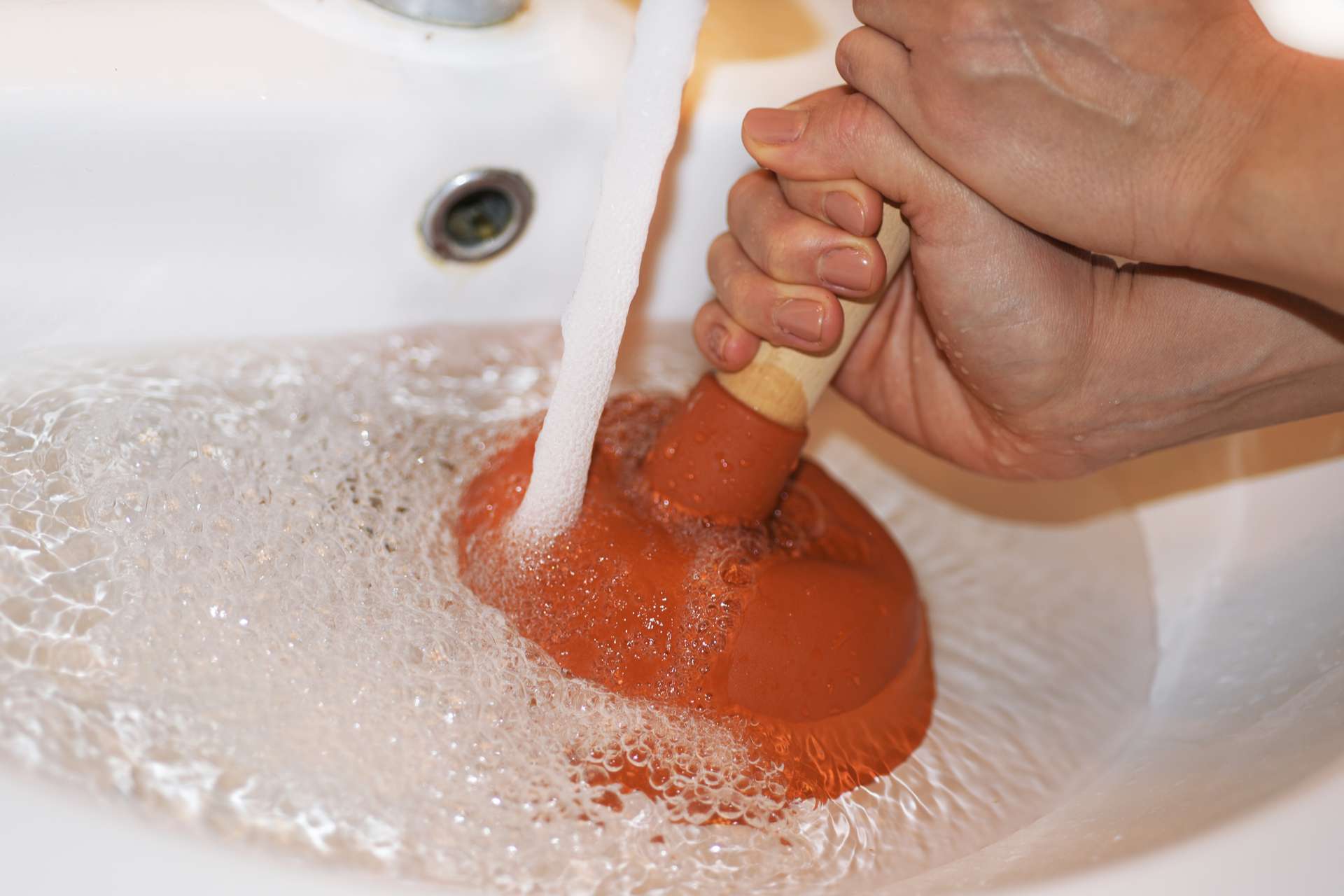
Mechanical tools like a plunger are effective for superficial blockages.
Chemical drain cleaners pollute wastewater and can damage pipes if used incorrectly.
The costs for professional drain cleaning by a plumbing company vary depending on the effort and time of day.
For emergencies on weekends or at night, significant surcharges apply for the on-call service.
The sooner you act on a slow-draining sink, the easier it is to fix the problem.
Important Drain Terminology
- Trap (Siphon)
The curved part of the drainpipe under the sink that serves as an odor seal. Dirt and hair often accumulate here.
- Plunger
A mechanical rubber tool that clears blockages through alternating negative and positive pressure. Also known as a force cup.
- Drain Snake
A flexible metal tool that is inserted deep into the pipe to mechanically break up stubborn blockages.
Option A: Home Remedies (Baking Soda & Vinegar)
- Best when: The water drains slowly and the blockage is just starting to form.
- Cost & Time: Under 5 CHF / approx. 30 minutes reaction time.
- Risks & Disadvantages: Ineffective for completely clogged pipes.
- Who does it: DIY.
Option B: Mechanical Cleaning (Plunger & Snake)
- Best when: The blockage is already stuck but is still in the front section of the pipe (e.g., in the trap).
- Cost & Time: 10–30 CHF (purchase) / 10–15 minutes of work.
- Risks & Disadvantages: Improper use of the drain snake can scratch the inside of the pipe.
- Who does it: DIY.
Option C: Professional Drain Cleaning
- Best when: Nothing drains anymore, the water backs up, or the blockage is deep in the sewer system.
- Cost & Time: 150–400 CHF (standard service) / usually done within 1–2 hours.
- Risks & Disadvantages: Higher costs, especially for emergency services (300–500 CHF).
- Who does it: Plumber or specialized drain cleaning company.
Step-by-Step: Clearing the Drain with Baking Soda and Vinegar
This environmentally friendly method effectively dissolves grease, soap residue, and minor blockages without damaging the pipes.
Remove standing water: Scoop the water out of the sink if it has backed up.
Add baking soda: Pour 3 to 4 tablespoons of baking soda (or baking powder) directly into the clogged drain.
Pour in vinegar: Follow up with half a cup of concentrated vinegar. Caution: The mixture will start to fizz immediately.
Let it sit: Cover the drain with a damp cloth and let the mixture work for 15 to 30 minutes.
Rinse with hot water: Carefully pour about a liter of boiling water down the drain to wash away the dissolved residue. Keep your distance to avoid splashes in your face.
If the water still does not drain afterwards, the blockage is deeper. In this case, you should use mechanical tools or contact a professional.
Frequently Asked Questions About Drain Cleaning
Here you will find the most important answers regarding clogged pipes and how to clean them.
For a standard service during regular working hours, you should expect costs between 150 and 400 CHF. An emergency call-out on the weekend or at night usually costs between 300 and 500 CHF.
In Switzerland, cleaning up to the trap is considered minor maintenance and is the tenant's responsibility. Blockages deep in the plumbing system are generally covered by the landlord, provided there is no clear fault on the part of the tenant.
In the shower and bathtub, hair and soap residue are usually the culprits. In the kitchen, grease and food scraps often lead to deposits that narrow the pipe's diameter over time.
Professionals advise against aggressive chemical cleaners. They heavily pollute wastewater, can generate heat if dosed incorrectly, and in the worst case, deform or permanently damage plastic pipes.
The simplest and most effective measure is a hair strainer for a few francs. It also helps to flush the drain with boiling water once a week to dissolve grease residue early on.
Do not hesitate to contact a plumbing company for recurring problems to avoid major water damage.
More articles about Bathroom
Toilettensitzerhöhung: Wertvolle Alltagshilfe für Senioren und Menschen mit Behinderung
Read article
So befreien Sie die verstopfte Toilette!
Read article
Wasserhahn tropft – So gelingt die Reparatur
Read article