Naturopath with federal diploma in Traditional Chinese Medicine (TCM) – Acupuncture
Services
- Acupuncture (TCM)
- Traditional Chinese Medicine (TCM)
- Electroacupuncture (TCM)
- Ear acupuncture (TCM)
- Moxa, moxibustion (TCM)
In Traditional Chinese Medicine, the body, soul, and environment are not viewed separately, but rather as an individual unit. Consequently, an illness is always seen as an interplay between objective findings (pulse and tongue diagnosis, skin color, stool and urine tests) and subjective well-being.
Traditional Chinese medicine finds its expression in the regulatory concepts of qi, yin, and yang, as well as the five elements:
Qi
In the Western world, the term Qi is often translated as "energy." However, this only reflects part of the meaning of a Chinese word that seems to elude any clear translation.
The Chinese character Qi is actually composed of two words, "vapor/steam" and "rice." This is intended to express that Qi can be immaterial like steam on the one hand, and material, as dense as rice, on the other. In Chinese medicine, Qi is therefore the basis of all material and spiritual life. Thus, the expression "Qi flows" does not so much mean that energy flows, but simply that the mechanisms of life are functioning. To illustrate this, here is a quote from Wang Chong (Chinese physician, 27-97 AD): "Qi forms the human body, just as water becomes ice. Just as water becomes ice, so too does qi gather together to form the human body."
Yin and Yang
Yin and Yang embody opposites – but also complementarity. One cannot exist without the other. Yin contains the seed of Yang within it and vice versa. These symbols describe the stages of a cyclical movement, whereby one flows into the other, just as day turns into night and vice versa.
Yin stands for the moon, cold, night, the feminine, and substance, for example. Typical yang characters or designations are the sun, warmth, day, the masculine, or (incorporeal) energy. In traditional Chinese medicine, it is important that yin and yang are in balance, because only then can human well-being be guaranteed.
To better understand this: if a person is neither too warm nor too cold, this means that yin and yang are in balance. However, if they are too cold, this can mean that they have too much yin (e.g., when the outside temperature is low = excess yin) or too little yang (e.g., when exhausted due to energy loss = lack of yang), which means that, relatively speaking, they have too much yin = cold.
Five elements or functional circuits
Another important concept in TCM is the five elements or functional circuits: water, fire, wood, metal, and earth. Each of these five elements is associated with characteristics such as specific seasons, organs, colors, emotions, tastes, climatic factors, and much more.
- Water: winter, kidneys, black, fear, salty, cold
- Fire: summer, heart, red, joy, bitter, heat
- Wood: spring, liver, green, anger, sour, wind
- Metal: autumn, lungs, white, sadness, dryness
- Earth: Late summer (or the middle of the seasons), spleen, yellow, brooding, dampness
These five elements support and complement each other, just as the year is made up of the seasons. However, they also control and balance each other, similar to the harmonious cycle of the seasons.
The symptoms and signs (of illness) associated with the five elements signal to the TCM doctor which of the five functional circuits is disturbed and where the causes may lie. A simplified example: A patient suffers from a dry cough in the fall. In this case, it is easy for the doctor to see that the metal element is affected. To strengthen this functional circle, he can administer herbs to the patient or stimulate meridian points associated with this element. In this context, another important aspect becomes clear: Traditional Chinese Medicine does not "repair" – rather, it strengthens and activates the body's self-healing powers.
Methods of TCM
Acupuncture
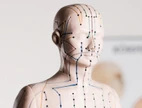
In this healing method, which is now also increasingly used in the Western world, specific areas of the skin—acupuncture points located on meridians—are stimulated with needles.
Phytotherapy
In China, the use of herbs to maintain health and combat disease is much more important than acupuncture. In the Western world, however, Chinese herbs are used less frequently, as working with these recipes requires a more in-depth knowledge of traditional Chinese medicine than is the case with acupuncture.
Tuina (An Mo)
This form of treatment is very similar to acupuncture. However, Tuina does not use needles; instead, the meridians and acupuncture points are treated using special massage techniques.
Qi Gong, Tai Qi
After receiving basic instruction, the patient should eventually be able to perform these gentle movement techniques independently. The aim of the exercises is to harmonize and center the body and mind. Qi Gong and Tai Qi are not so much independent therapies as important accompanying measures. Tai Qi is also known as "shadow boxing."
Nutrition
Certain properties are also consistently attributed to nutrients. Therefore, changing one's diet is an important factor in traditional Chinese medicine in order to lead a life of harmony and balance.
Where are TCM methods used?
In China, there are no restrictions on indications, which is clearly demonstrated by the fact that almost every hospital has its own TCM department.
In Europe, acupuncture is often used to treat disorders and pain of the musculoskeletal system. Due to the scientific evidence of its effectiveness in certain areas, health insurance companies are also willing to cover some or even all of the costs in these cases. However, this is subject to the condition that the treatment is carried out by a doctor who holds an acupuncture diploma from the Austrian Medical Association.
According to experience reports, therapy using herbs and similar substances has shown good results in treating functional disorders and chronic infections.
Where can you find information or training?
The Austrian Medical Association offers a diploma in acupuncture. To obtain this diploma, a course comprising 100 hours of theory and 40 hours of practical training (work experience) must be completed. The course concludes with a practical and theoretical examination. The diploma requires a ius practicandi (license to practice as a general practitioner).
The acupuncture diploma is now widespread among the medical profession. This also means that some doctors practice acupuncture only rarely or only as a sideline. So don't be afraid to ask your doctor how much experience they have in this field before starting treatment.
Training to become a traditional Chinese doctor (training in phytotherapy, nutrition, and traditional forms of diagnosis) is standardized in Austria by a Medical Association diploma.
The training program lasts at least two years with a total of at least 500 teaching units of 45 minutes each; about two-thirds of this is devoted to seminars and courses and one-third to practical training.